

As volatility in energy markets pushes operators to rethink how they power their fleets, BAR Technologies – a spin-off from Great Britain’s former America’s Cup Team – says fuel strategy in global shipping is increasingly being shaped by immediate commercial realities rather than long-term decarbonisation targets.
A combination of infrastructure disruption, geopolitical risk and persistent uncertainty around key maritime corridors is exposing the fragility of single-fuel strategies, according to BAR – a company that provides design and engineering consultancy across commercial ships, workboats, leisure boats, and engineered solutions.
At the same time, constraints around the availability of alternative fuels are limiting the industry’s ability to follow a linear transition pathway.
The result, BAR Technology argues, is a decisive shift towards fuel flexibility as a core commercial requirement rather than a sustainability preference.
BAR Technology’s team includes world-leading naval architects, optimisation specialists, fluid dynamists, and system engineers, all focused on delivering next-generation maritime technology.
John Cooper, CEO of BAR Technology, says: “Let’s be clear – the current situation is exposing the commercial risk of relying too heavily on fossil fuels. The direction of travel is towards a more stable and ultimately more profitable model, where not all of your energy is bought on the market.”
According to BAR, dual-fuel vessels, once positioned primarily as a bridge to lower emissions, are increasingly being treated as a hedge against volatility.
Fuel price spike shocks industry
Since the US-Iran conflict, which began on 28 February, oil and gas prices have rocketed. On Thursday 19 March, Brent crude, the international standard, briefly rising above $119 per barrel, up from roughly $70 before the conflict began.
In the US, the nationwide average price of gas reached $3.94 on 22 March.
In its latest report, BAR states that ‘fleet deployment decisions are being shaped as much by fuel availability as by demand, while shifting trade flows continue to alter cost dynamics across key routes.’
Wind assisted propulsion
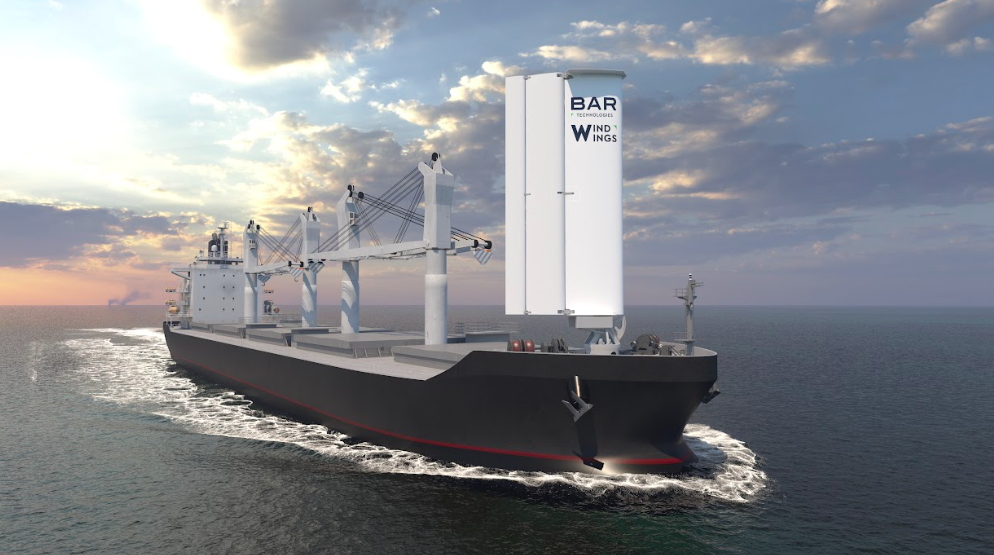
It reports renewed attention on the role of wind-assisted propulsion within the fuel mix. In May 2025, BAR Technologies’ 37.5m WindWings system received Type Approval Design Certification from Bureau Veritas.
While not a standalone solution, wind offers a distinct advantage in a volatile market: it is not exposed to fuel pricing and, with advances in weather routing and voyage planning, can be forecast and integrated into operations with increasing precision.
“Wind won’t replace fuel, but it changes the risk profile,” Cooper adds. “If part of your energy input isn’t bought on the market, you’re less exposed. That starts to matter when volatility becomes the norm, not the exception.”
According to BAR Technology, this marks a structural change rather than a temporary adjustment. Energy markets are becoming less predictable, and operators are responding by building resilience into how they power and deploy their fleets.
“Everyone talks about transition as if it’s a straight line,” Cooper says. “It isn’t. It’s uneven, and it’s being shaped by real-world constraints. The companies that build flexibility into their operations will be the ones that come through this strongest.”
While decarbonisation remains a long-term objective, the immediate priority is managing uncertainty. In that environment, optionality, across fuels, routes and technologies, is increasingly defining commercial performance.
The post Fuel strategies shift amid market volatility appeared first on Marine Industry News.