Hydrogen propulsion has cleared another milestone on its journey from demonstration projects to commercial deployment. Lloyd’s Register has issued the first Type Approval Certificate for a 100 per cent hydrogen-fuelled, spark-ignited marine engine, providing independent validation of a technology many believe could play a significant role in shipping’s transition to net zero.
The approval has been awarded to the hydrogen engine developed by BeHydro and confirms the design meets Lloyd’s Register requirements for safety, performance and reliability in marine applications.
Designed to run entirely on hydrogen
The engine was developed and tested at ABC Engines’ facility in Ghent and is designed to operate entirely on hydrogen, without the need for pilot fuels. This simplifies system design and eliminates onboard carbon emissions at source, positioning the technology as a practical option for operators pursuing zero-carbon propulsion.
“The issue of this Type Approval Certificate demonstrates that hydrogen-fuelled internal combustion engine technology is continuing to mature as a viable option for maritime applications,” says Claudene Sharp-Patel, global technical director for Lloyd’s Register. “For shipowners and operators, independent certification is essential in building confidence that emerging fuel technologies can meet the industry’s expectations for safety, reliability and operational performance.”
BeHydro expands beyond dual-fuel technology
Lloyd’s Register previously awarded Type Approval to BeHydro for its hydrogen-powered dual-fuel engine in 2023, marking the first Type Approval for a dual-fuel hydrogen engine.
BeHydro is a joint venture between Belgian companies ABC Engines and Cmb.Tech, with ambitions extending beyond marine applications into rail and power generation.
Tim Berckmoes, CEO of ABC Engines, says the approval for a zero-emission hydrogen engine confirms the future-proof technology BeHydro can offer to innovative shipowners worldwide.
“The 100% hydrogen engine range is available from 900 kW till 2670 kW for different marine applications.”
Regulation and infrastructure remain key challenges
As a marine fuel, hydrogen has the potential to support the shipping industry’s goal of achieving net-zero emissions by 2050, helping eliminate greenhouse gas emissions while improving air quality, according to a recent Lloyd’s Register report.
Like other zero-emission solutions, hydrogen faces technical, commercial and regulatory challenges. However, the report’s authors say there are currently no fundamental barriers to widespread adoption. The development of hydrogen infrastructure will require significant investment, particularly due to specialised storage and transportation requirements.
On the regulatory front, growing recognition of hydrogen’s role in decarbonisation is driving the development of national hydrogen policies and technical standards. Within shipping, regulations governing hydrogen remain incomplete, but interim guidelines for its safe use are being developed at the International Maritime Organisation. These are expected to provide greater clarity and support wider adoption. The work is critical to understanding and managing risks associated with hydrogen onboard, including fire and explosion hazards.
Commercial viability still the biggest hurdle
Technology development continues to advance rapidly and operational experience with hydrogen in shipping is growing, often through government-backed projects. The report identifies commercial viability as the sector’s biggest challenge, with uptake ultimately dependent on the pace of global decarbonisation efforts. The full report is available via Lloyd’s Register.
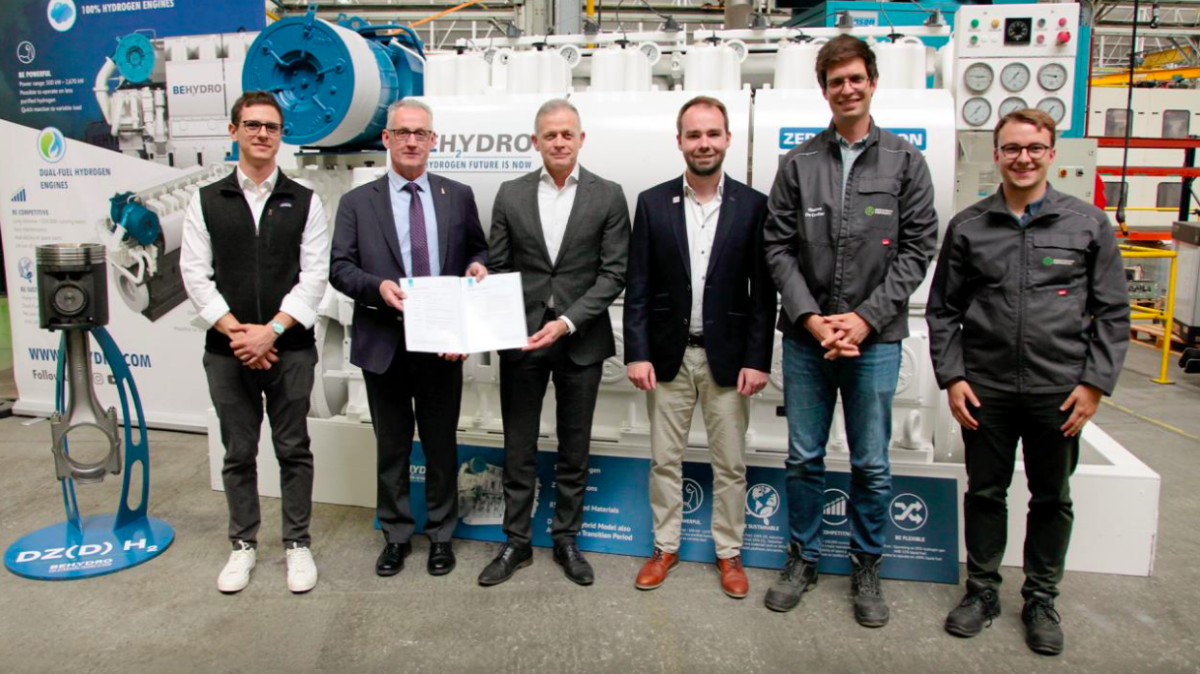
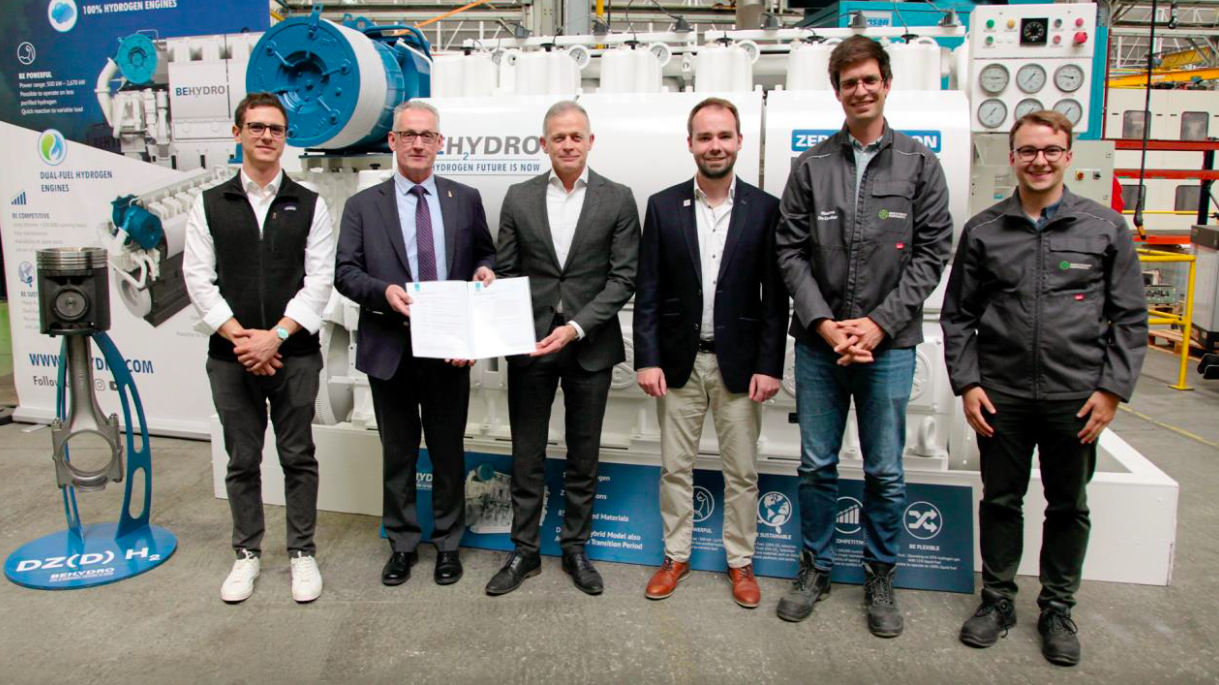
Pictured above (L-R): Michail Cheliotis, marine surveyor, Lloyd’s Register; Peter Van de Graaf, strategic key account business partner, Lloyd’s Register; Tim Berckmoes, CEO, Anglo Belgian Corporation; Louis Vercauter, project coordinator, Cmb.Tech; Edward Belderbos, project engineer, Anglo Belgian Corporation; and Arthur Ghekiere, project engineer, Anglo Belgian Corporation.
The post World’s first class-approved 100% hydrogen marine engine clears major commercial hurdle appeared first on Marine Industry News.