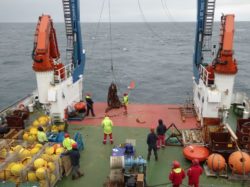
RRS Discovery left Southampton last Thursday en route to the Iceland Basin and Rockall Trough. It’s part of a research expedition aimed at enhancing understanding of the role of this part of the ocean in the climate and weather in Europe and the Arctic.
Currently a lack of measurements of how much heat and freshwater is carried northwards by the North Atlantic subpolar gyre is holding back the progression of understanding about the relationship between ocean currents and UK climate.
Scientists know that the gyre currents bring warm waters flowing past the UK, and that heat from the ocean is released into the overlying air. When the currents change and the surface ocean becomes warmer, UK and Europe can experience winter weather that is colder and more severe than usual. What is not clear is exactly how changes in the ocean to the west of the UK are driving weather and climate.
To address this gap in the data, the crew, scientists and technicians on board the RRS Discovery will recover and re-deploy moorings that have been continuously measuring velocity, temperature and salinity for the past two years. They will also collect a series of salinity, temperature and oxygen profiles from the sea surface to the seafloor.
Additionally, the expedition will visit the Darwin Mounds Marine Protected Area to gather data that will help explain the role of local ocean currents in nurturing the regrowth of deep-cold-water corals following damage inflicted by fishing and natural hazards.
The growth of cold-water corals depends on the supply of food from the sun-lit surface layer of the ocean and carried to the corals by currents. Scientists expect to find that the strength of the currents is one factor in determining how well the slow-growing coral mounds have recovered after seafloor trawling was banned in the area in 2003.
This research expedition forms the latest in a long series of visits to this remote region of the eastern North Atlantic, which have been going since 1975.
The project is part of CLASS, a five-year project funded by the Natural Environment Research Council that will deliver the knowledge and understanding of the Atlantic Ocean system that society needs to make evidence-based decisions regarding ocean management. CLASS aims to address key knowledge gaps in understanding ocean variability, climate regulation and ocean services, and to assess how the ocean will evolve as a result of climate change and intensified human exploitation.