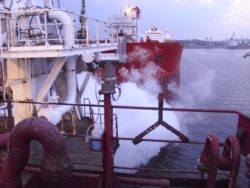
Survitec has introduced a new service aimed at ensuring CO2 low pressure (LP) firefighting systems are correctly deactivated when ships enter lay-up.
The turn-key CO2 LP lay-up service, developed in collaboration with a leading European-based shipowner, was introduced two-months-ago following market demand for a solution capable of simplifying decommissioning and recommissioning procedures.
Survitec has already seen an upswing in demand for the service following a surge in the number of ships temporarily suspending services and deactivating ships due to the lack of trade.
“Due to the pandemic and the on-going economic uncertainty, we are seeing ro-ro vessels, VLCCs, and large bulk carriers and containerships heading for lay-up, with owners looking to ensure their CO2 systems are deactivated correctly and safely,” says Claude Sada, COO, Survitec.
A CO2 LP system, typically used in a vessel’s fixed-fire extinguishing arrangement, can only be decommissioned and recommissioned by a specially trained service provider once the Classification Society has granted approval for the system to be deactivated and the tank emptied.
Survitec has Z17 approvals as service suppliers – from various classification societies – allowing the company to service and maintain a vessel’s multi-branded fire-extinguishing systems, including CO2 LP systems.
Steven Puis, Survitec training manager for technical support, says that while cold lay-up procedures are similar to the processes carried out during the periodical service or refilling of the CO2 system, there are subtle differences.
“In addition to stringent ventilation, gas detection and personnel safety requirements, cooling compressors need to be prepared prior to tank emptying. Once the compressors are safe, the tank must be emptied through the liquid filling line instead of the gas/vapour return line to avoid a rapid drop in pressure and the CO2 turning into a solid block of ice.
“When the tank has been emptied of its liquid content and pressure is maintained at about 10 bars, it avoids the need for any hydro and pressure testing, internal tank cleaning and purging when the system is reactivated. There is no risk of damage caused by humidity or water accumulating inside the tank.”
With shipowners unprepared for the rapid and extended economic crisis the on-going pandemic has created, the shortfall in trade volumes is resulting a need to protect revenues and scale back operations. For many, a cold lay-up is the best way of reducing overheads.